SLAT Colloquium: Dr. Wenhao Diao (University of Arizona)

Chinese Language Teachers in American K-12 Schools

When
2 – 3 p.m., Feb. 21, 2025

Colloquium Title: Chinese Language Teachers in American K-12 Schools

Colloquium Abstract: This mixed-methods study investigates the negotiation of their professional identity among Chinese language teachers in K-12 schools, and how it may intersect with their ethnic and racial positionings. Although the field of language teaching is paying increasing attention to how ethnicity and race may enter teachers’ professional lives is an increasingly important topic in the field of language teaching, the published research continues to be dominated by the teaching/learning of English as a second language (Von Esch, Motha, & Kubota, 2020). Set mostly in 2021 when there was widespread surge of anti-Asian violence, this project directs our attention to the experience of Chinese language teachers in a particular moment. Here the focus is the interviews and journal data collected from 27 Chinese teachers, who were selected as a balanced representative sample from the 221 participants who completed our national survey. The themes that emerged in our data highlight the intersectionality between language, nation, ethnicity, and race in Chinese language teachers’ professional work. In particular, the teachers’ discourse highlights three themes: 1) linguistic alienation of Chinese-ness, 2) culture-based exclusion, and 3) dealing with other forms of discrimination. Moreover, as the teachers described these challenges also as opportunities for inclusive language pedagogies, and they show examples of how to address justice in their own language classrooms, the findings here underscore anti-discrimination possibilities in and through language teaching.

Speaker Bio

Wenhao Diao is an Associate Professor and interim Head in the Department of East Asian Studies and an affiliated faculty member in the interdisciplinary doctoral program of Second Language Acquisition and Teaching at the University of Arizona. She founded and co-directs the Center for East Asian Studies, a Title VI National Resource Center supported by the U.S. Department of Education, at the University of Arizona. She received her Ph.D. from Carnegie Mellon University and her B.A. and M.A. from East China Normal University. As an applied linguist, she is interested in the identities and ideologies that Chinese language learning and teaching (re)produce and (re)distribute. Her research has primarily focused on Chinese language teachers in K-16 contexts, as well as the phenomenon of study abroad - particularly going to and from China. Her work has been funded by the U.S. Department of Education and the Chinese Language Teachers Association (USA). She was awarded a Fulbright-Hays grant in 2017 for her proposed project that connects educators in the U.S. with their peers in China. Her articles have appeared in journals such as Applied Linguistics, Modern Language Journal, System, and so on. With her colleagues in the field, she has published an edited book entitled Language Learning in Study Abroad: The Multilingual Turn (Multilingual Matters, 2021) and a guest-edited special issue themed Study Abroad in the 21st Century for the L2 Journal in 2016. Prior to joining the University of Arizona, she taught at Middlebury College, Carnegie Mellon University, the University of Virginia, and East China Normal University.

Image
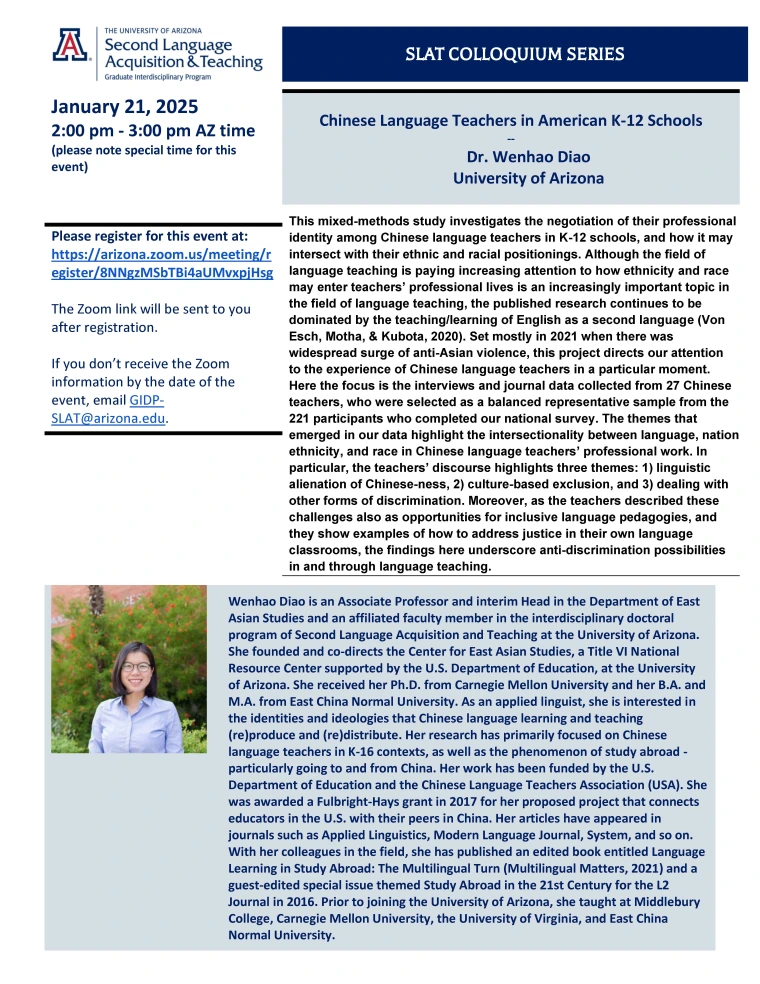
colloquium flyer

SLAT Webinar: Financial Literacy

Dr. Dan MacDonald, Andrew Waldum, Dr. Stefan Vogel

When
4 – 5 p.m., Feb. 6, 2025

Panelists: Dr. Dan MacDonald, Andrew Waldum, Dr. Stefan Vogel

Moderator: Maryah Converse, 4th-year SLAT Candidate

Panelist Bios

Dr. Dan McDonald is the Director of the Take Charge America Institute for Consumer Financial Education and Research, is an Extension Specialist in Financial Education, and a Distinguished Outreach Professor. Dr. McDonald has worked at the University of Arizona for 24 years, designing, implementing, and evaluating community programs. He oversees personal finance outreach programming offered through Cooperative Extension throughout the State of Arizona, including five Tribal Nations, and he is the project director for the Children, Youth, and Families at Risk sustainable communities project.

Andrew Waldum, M.B.A, CFP is an Associate Professor of Practice in Personal and Family Financial Planning at the University of Arizona’s Norton School of Human Ecology. He has worked in a number of different settings and roles, but for several years now he has been teaching university courses with an emphasis in Personal and Family Financial Planning at Central Washington University and at the University of Arizona. He is passionate about financial planning education and truly believes that crafting and following a solid financial plan can truly change people’s lives for the better. Professor Waldum has a M.B.A. with concentrations in Finance and International Management from the University of New Mexico - Albuquerque, and a Graduate Certificate in Personal Financial Planning from Kansas State University.

Dr. Stefan Vogel is a lecturer at the University of Albany, SUNY, where he teaches in the Writing and Critical Inquiry Program. He graduated from the SLAT PhD program in August 2021. As a former international student in SLAT, he has a unique perspective on how financial literacy can affect graduate students and prepare them for life in graduate school and beyond. Dr. Vogel’s primary academic interests and areas of specialization are second language writing, second language teacher education, as well as leadership and program administration. 

Image
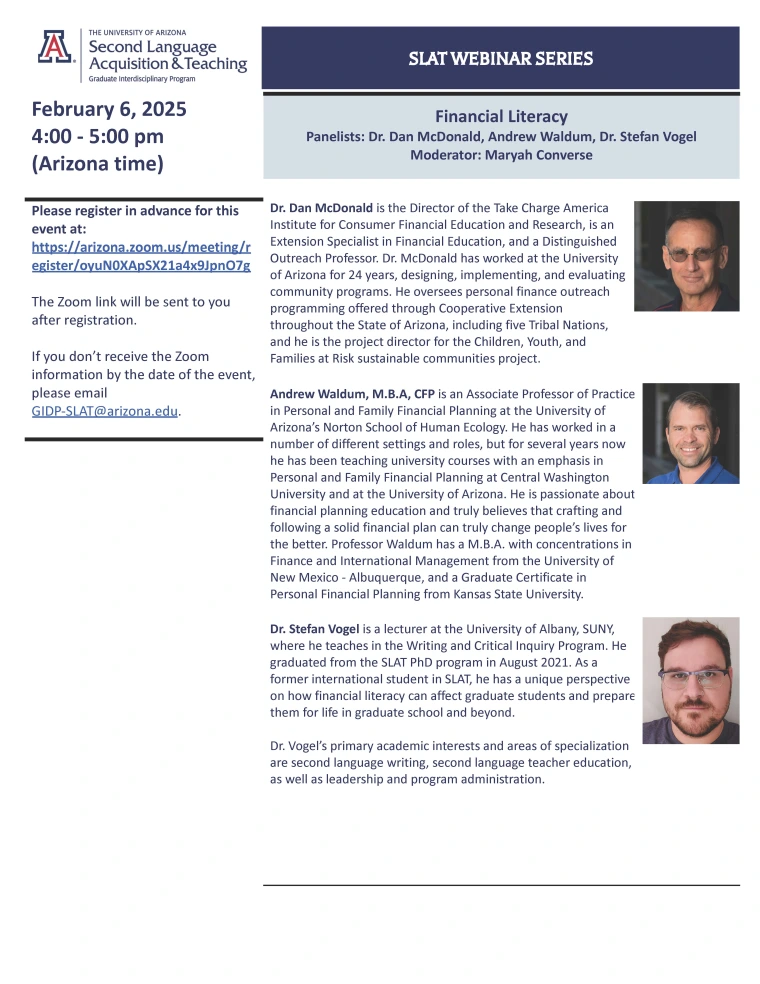
SLAT webinar flyer

SLAT Colloquium: Dr. Marion Tellier (Aix-Marseille Université, Laboratoire Parole et Langage)

Giving a hand to learning: Pedagogical gestures in the language classroom

When
10 – 11 a.m., Jan. 17, 2025

Colloquium Title: Giving a hand to learning: Pedagogical gestures in the language classroom

Colloquium Abstract: Several studies in classroom contexts from the fields of language teaching, gesture studies, and cognitive science have demonstrated the usefulness of communicative teacher actions performed with the body (e.g. gesture, gaze, posture, and facial expressions) (Azaoui, 2020; Matsumoto & Canagarajah, 2020; Nakatsukasa, 2016; Tellier, 2014). The teacher’s ‘pedagogical gestures’, as we refer to it here, contribute to the teacher’s functions in the classroom such as informing (i.e. providing information about the language), assessing (i.e. giving feedback to learners) and managing (i.e. managing speech turns and giving instructions) (Tellier, 2008a). Language teachers have a specific way of combining speech and gestures to convey their message, especially   when they use only the target language in the classroom.

The effect of pedagogical gestures on learning has been a recent focus in both ecological and experimental studies, underscoring its positive role in helping learners acquire an additional language. For instance, gestures and other visual cues help learners to access meaning in the target language (Sime, 2008; Sueyoshi & Hardison, 2005; Tellier, 2008a). Moreover, a number of experimental studies have also demonstrated the significant effect of hand gestures on memorization, particularly on  lexicon learning (Allen, 1995; Macedonia & Klimesch, 2014; So et al., 2012; Tellier, 2008b). 

Experienced teachers tend to use their body as a pedagogical tool, and they are aware of it. Inexperienced teachers, however, often struggle to  use their bodies effectively (Tellier & Yerian, 2018; Yerian & Tellier, 2024) and must develop awareness of how to use their bodies as pedagogical affordances. In this talk, the developmental aspect of gesture as a professional technique will also be addressed.

Speaker Bio: Marion Tellier, Ph.D., is a professor of foreign language didactics at Aix Marseille Université and affiliated to the Laboratoire Parole et Langage (CNRS). Her research interests include foreign language teaching, pedagogical gestures, gestural adaptation, foreign language teacher training and professional gestural development. She has co-edited two volumes: Le corps et la voix de l’enseignant: théorie et pratique (The Teacher’s Body and Voice: A Theoretical and Practical Context) (Maison des Langues, 2014) and Enseigner à l’oral en ligne: une approche multimodale (Teaching orally online: a multimodal approach) (Didier, 2017). She is one of the co-founders of ISGS France (one of the national hubs of ISGS - International Society for Gesture Studies). She is currently the president of ASDIFLE (Association for French Didactics).

Location: Please register for this event at: https://arizona.zoom.us/meeting/register/bhNcSUZkSga_JG0YAhdGKA The Zoom link will be sent to you after registration. If you don’t receive the Zoom information by the date of the event, email GIDP-SLAT@arizona.edu.

Image
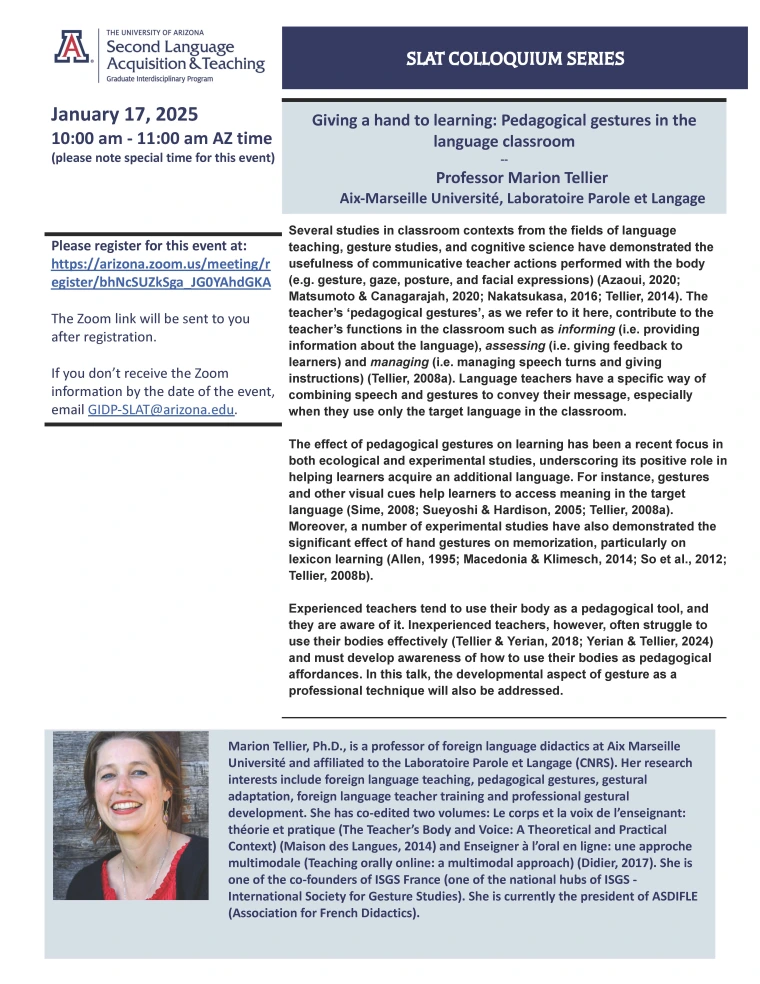
colloquium flyer

SLAT Proseminar Research Poster Presentations

All first-year SLAT major and minor students present their research agendas

When
10 a.m. – Noon, Dec. 6, 2024

The first-year SLAT major and minor students will present their Research Agenda posters in this final class presentation of the semester. All SLAT faculty and students are welcome to attend!

SLAT Colloquium: Dr. Doris Warriner (Northwestern University)

“English Saved me in a Way”: Ideological Work in Narratives of Displacement

When
1 – 2 p.m., Nov. 22, 2024

Language ideologies have captured the interest of scholars of language for more than 40 years, even as the construct has evolved over time. Theoretical and empirical investigations of language ideology have drawn attention to “the implicit understandings and unspoken assumptions embedded and reproduced in the structure of institutions and their everyday practices” (Gal, 1998, 319) and also to how such understandings and assumptions “endow some linguistic features or varieties with greater value than others, for some circumstances and some speakers” (Woolard, 2021, 2). In this presentation, I examine the “ideological work” (Irvine 2021) that is accomplished in two different first-hand accounts of displacement. In each case, the “ideological work” accomplished by the narrative contributes to a performance of a recognizable figure of personhood (Koven 2015, 2016; Park 2021) that establishes a distinctively moral stance. The first example comes from an interview with an adult learner of English about her lived experiences with language learning, resettlement and job hunting in the U.S. The second example is from an interview conducted with a community-based advocate-activist who once identified as a refugee and now works for the state’s Department of Economic Security. The analysis illuminates how speakers strategically mobilize and monopolize widely circulating ideologies of language that value English above other languages (and speakers of English over speakers of other languages) – and ultimately how this ideologizing invokes “figures of personhood” that also index a type of person or a broader social type “such as ‘being morally responsible’” (Park, 2021, 49).


Dr. Doris Warriner is a Professor in the Department of Anthropology at Northwestern University. With expertise in educational anthropology and linguistic anthropology, she investigates the social, political, economic, and ideological dimensions of language, literacy, and mobility. In her scholarship and teaching, she examines how social practices, understandings and policies are influenced by large-scale processes such as displacement, ethnic conflict, immigration, and transnationalism. Prior to joining Northwestern University, Warriner was a Professor of English at Arizona State University. In addition, Warriner has edited Refugee Education across the Lifespan: Mapping Experiences of Language Learning and Use (published by Springer in 2021) and has co-edited two volumes: Extending Applied Linguistics for Social Impact: Cross-Disciplinary Collaborations in Diverse Spaces of Public Inquiry (published by Bloomsbury in 2021) and Critical Reflections on Research Methods: Power and Equity in Complex Multilingual Contexts (published by Multilingual Matters in 2019).

Student Moderator: Asya Gorlova, 4th-year SLAT PhD Candidate

Image
SLAT colloquium flyer

SLAT Webinar: Starting in Language Program Administration

Dr. Jieun Ryu, Dr. Natalie Amgott, Dr. Rachel Floyd, Dr. Federico Fabbri

When
4 – 5 p.m., Nov. 7, 2024

Panelists: Dr. Jieun Ryu (University of Arizona), Dr. Natalie Amgott (Carnegie Mellon University), Dr. Rachel Floyd (University of Georgia), Dr. Federico Fabbri (University of Michigan)

Moderator: Dilara Avci, 2nd-year SLAT PhD Student

Panelist Bios

Dr. Jieun Ryu is an Assistant Professor of Practice in the Department of East Asian Studies at the University of Arizona, where she also serves as Co-Director of the Korean Language Program. She earned her PhD from SLAT in 2017. Before joining the East Asian Studies Department, she served as the Director of the Critical Languages Program at the University of Arizona for seven years and as a coordinator for two years. With over a decade of experience in language teaching and program administration, Dr. Ryu has developed and implemented innovative curricula, especially in the field of Less Commonly Taught Languages (LCTLs). She is passionate about exploring new methodologies to enhance language learning, including the integration of cutting-edge technologies in classroom practice. Dr. Ryu has been actively collaborating with many LCTL educators, including SLAT faculty and students, on interdisciplinary curriculum development initiatives.

Dr. Natalie Amgott is Associate Director of Online Language Learning at Carnegie Mellon University, where she also directs the Language Program Administration Certificate. A PhD graduate of SLAT at the University of Arizona, her research and practice center on curriculum design and program evaluation. She is recipient of the ACTFL Early Career Research Award and has published in Foreign Language Annals, System, TESOL Quarterly, and L2 Journal

Dr. Rachel Floyd holds a PhD in Second Language Acquisition and Teaching from the University of Arizona and a MA in French & Francophone Studies from the University of Tennessee. She specializes in the implementation of multiliteracies and critical pedagogies, and her research interests relate to the implementation of these pedagogies in the language classroom. She has also published articles related to the development of socio-emotional learning and digital literacies in the language classroom. She is currently the French Language Program Supervisor at the University of Georgia.

Dr. Federico Fabbri is the Director of the Elementary Language Program in Romance Languages at the University of Michigan. A PhD graduate of SLAT at the University of Arizona, his main areas of interest lie in Language Program Administration, particularly Enrollment & Retention, Curriculum Design, and Materials Development. Other academic interests include Open Educational Resources and L2 Autoethnography. 

Image
SLAT webinar flyer

SLAT Colloquium: Dr. Mascha N. Gemein (University of Arizona)

Equity-Minded Teaching 101

When
4 – 5 p.m., Oct. 25, 2024

UDL, DEI, oh my! Does it sometimes feel too overwhelming or abstract to even think about creating effective courses for our diverse learners? Let’s take this hour to get our bearings. We will demystify some popular terms (such as Universal Design for Learning, or Diversity, Equity, and Inclusion, among others) and explore what they all have in common when we consider the basic principles of our teaching practices. And when we look at some concrete examples we can apply next week or next semester, creating effective courses won't look so challenging anymore.

Dr. Mascha N. Gemein is an Associate Professor of Practice at the University Center for Assessment Teaching and Technology at the University of Arizona. An international scholar and educational developer with particular focus on equity, intercultural learning, and evidence-based curriculum development, she supports faculty through consultations, professional development programs, and learning communities. She also serves as advisor, coordinator, and faculty member of the College Teaching Graduate Interdisciplinary Program.

Student Moderator: Dilara Avci, 2nd-year SLAT PhD Student

Image
colloquium flyer

SLAT Webinar: Educational Service Jobs

Dr. Lisa Jurkowitz, Dr. Kara McBride, Dr. Tahnee Bucher

When
4 – 5 p.m., Oct. 10, 2024

Panelists: Dr. Lisa Jurkowitz (Pima Community College), Dr. Kara McBride (World Learning), Dr. Tahnee Bucher (Michigan Language Assessment)

Moderator: Angus Leydic, 3rd-year SLAT PhD student

Panelist bios

Dr. Lisa Jurkowitz was raised in Arizona but lived in France for several of her school-age years. The experience of studying abroad and traveling throughout Europe with her family sparked her early interest in languages and cultures. At university, she pursued Bachelors and Masters degrees in French Literature & Pedagogy, with a minor in Spanish. Subsequently, she earned her PhD in SLAT from the University of Arizona. Since 2000, she has taught English as a Second Language as a full-time faculty member at Pima Community College in Tucson, Arizona. Throughout her tenure, she has served in various leadership positions and is currently serving as the ESL Department Head. 

Dr. Kara McBride serves as Senior Technical Education Specialist at World Learning and Assistant Professor at SIT Graduate Institute. She focuses on teacher training and curricular reform across a range of programs in Central Asia, the Middle East, and globally. She served as World Learning’s technical specialist for a USAID-funded education project in Lebanon, which works to improve reading and writing instruction for grades 1-6, across three languages, and the integration of social and emotional learning into all aspects of schoolchildren’s education. Kara has led the design of online teacher training courses that have been completed by more than 35,000 teachers from over 120 countries, including Integrating Critical Thinking into the Exploration of Culture in an EFL Setting and Content-Based Instruction, both of which form part of the US Department of State’s Online Professional English Network (OPEN). Before coming to World Learning, Kara was an Associate Professor in the Department of Languages, Literatures, and Cultures at Saint Louis University, where she served first as director of the basic Spanish Language Program and, later, as Director of the Spanish Masters program. Kara graduated from SLAT in 2007. 

Dr. Tahnee Bucher (Ph.D. SLAT, University of Arizona; M.A. TESOL, West Virginia University) specializes in classroom language assessment and language proficiency testing. With extensive experience in the field, she has held diverse roles, including ESL/EFL instructor, teacher trainer, test consultant, assessment coordinator, and assessment developer. Currently, she serves as the Assessment Innovation and Alignment Manager at Michigan Language Assessment. In this role, she bridges research and action to ensure exams remain fit for purpose, while also evaluating, recommending, and implementing content and process changes to support validity and scalability.

Image
SLAT webinar flyer

SLAT Workshop: Software Programming for SLAT

An introductory workshop on how to program software for SLAT data research purposes

When
1:30 – 3 p.m., Nov. 8, 2024
This workshop has been rescheduled from October 18th to November 8th.

In this workshop, Dr. Hammond will go over why somebody in SLAT might want to learn to program. He'll review what programming is, why SLAT students might want to learn how to do it, and will give examples and hands-on experience of three kinds of programming that SLAT students could choose between, depending on their needs and interests: shell commands, prolog, and python. These three approaches exemplify different kinds of programming that appeal to people with different kinds of needs, interests, and available time.

Presenter: Dr. Mike Hammond

This workshop will be held in person in the Art Building, room 140.

SLAT Comprehensive Exam Workshop

The details about the SLAT comprehensive exam process

When
4 – 5:30 p.m., Oct. 3, 2024

This workshop will cover what to expect from the comprehensive exam process, when to start putting committees together, how to put together reading lists, how to tie in your dissertation proposal topic, and much more. All SLAT students in their 2nd and 3rd years (especially those who are taking comps during 2024-2025) are required to attend, but all SLAT major and minor students from any cohort are welcome.

Presenter: Dr. Suzanne Panferov Reese