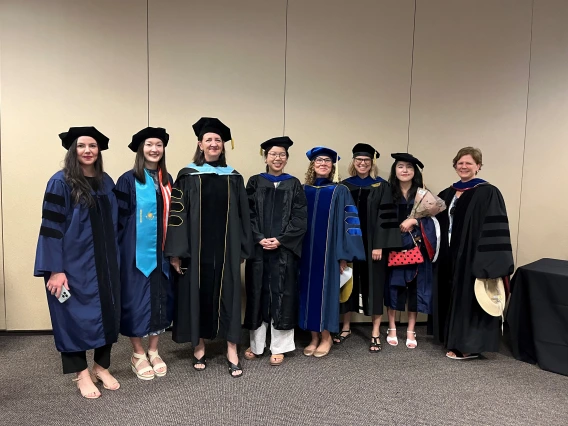
Dissertation Title: Developing L2 pragmatic competence through collaborative dialogue: A study on EFL learners' request-making in interaction
Dissertation Committee: Dr. Peter Ecke (Chair), Dr. Janice McGregor, Dr. Eliane Rubinstein-Avila
Abstract: Over the years, second language acquisition (SLA) researchers have become increasingly interested in the teaching of second language (L2) pragmatics. Among the questions that they have addressed are whether L2 pragmatics is teachable; whether instruction produces better results than exposure alone; and whether different teaching methods lead to different learning outcomes (Plonsky & Zhuang, 2019; Rose, 2005; Taguchi, 2015). Today, a large body of research exists on instructed pragmatics learning. However, given their predominantly cognitive/psycholinguistic orientation (Taguchi, 2011, 2015; Taguchi & Roever, 2017), most interventional studies have focused on comparing the benefits of explicit and implicit instruction. In addition, pragmatic features such as speech acts have been commonly taught as single-turn utterances, disregarding the fundamentally co-constructed and interactional nature of their production and achievement in conversation (Félix-Brasdefer, 2019; Kasper, 2009).
The present study aimed to fill these gaps in the literature by investigating the effects of collaborative dialogue on L2 learners’ awareness and use of requests in interaction. In addition, the study aimed to document the nature of the collaborative dialogue that the learners generated through consciousness-raising (CR) tasks and how such collaborative dialogue was mediated by their L2 proficiency level. The participants were ten Spanish-speaking learners of English as a foreign language who were divided into low-, mid-, and high-level dyads and asked to verbalize their reflections as they compared their requests with those produced by English native speakers in the same situations. During task performance, the learners’ collaborative dialogue was audio-recorded and subsequently analyzed for the quantity (occurrence), type (focus), and quality (level of engagement) of the pragmatic-related episodes (PREs) created. Instructional effects were assessed by analyzing, quantitatively and qualitatively, the collaborative dialogue data (PREs) and the request-data (roleplays) that were collected during the study.
The results indicated that in comparison to other tasks used in the instructed L2 pragmatics literature, the frequency of the PREs produced through CR tasks seemed to be higher. Most of the PREs dealt with pragmalinguistics, followed by those focused on sociopragmatics, and discourse. The PREs elicited more limited than elaborate engagement. In addition, L2 proficiency seemed not to affect the quantity, type, and quality of the learners’ PREs. In terms of instructional effects, the results showed gains in the learners’ production of requests in interaction, as evidenced by the range of request strategies, request modifiers, and patterns of sequential organization that they employed in their roleplays. The frequency of use of such request features was found to be associated with the quality of the PREs, that is, the more the learners discussed the features with elaborate engagement, the more they supplied them in their roleplay interactions. Finally, analysis of the learners’ verbalized reflections demonstrated that collaborative dialogue did not raise their L2 pragmatic awareness, as they were unable to fully understand the rules and conventions underlying the appropriate use of requests in interaction.
Please note that this will be a private defense, and not open to the public.