CANCELED: SLAT Webinar - Qualitative Data Collection: What Could Go Wrong, What Could Go Right?
This webinar has been canceled. We're sorry for the change in schedule.
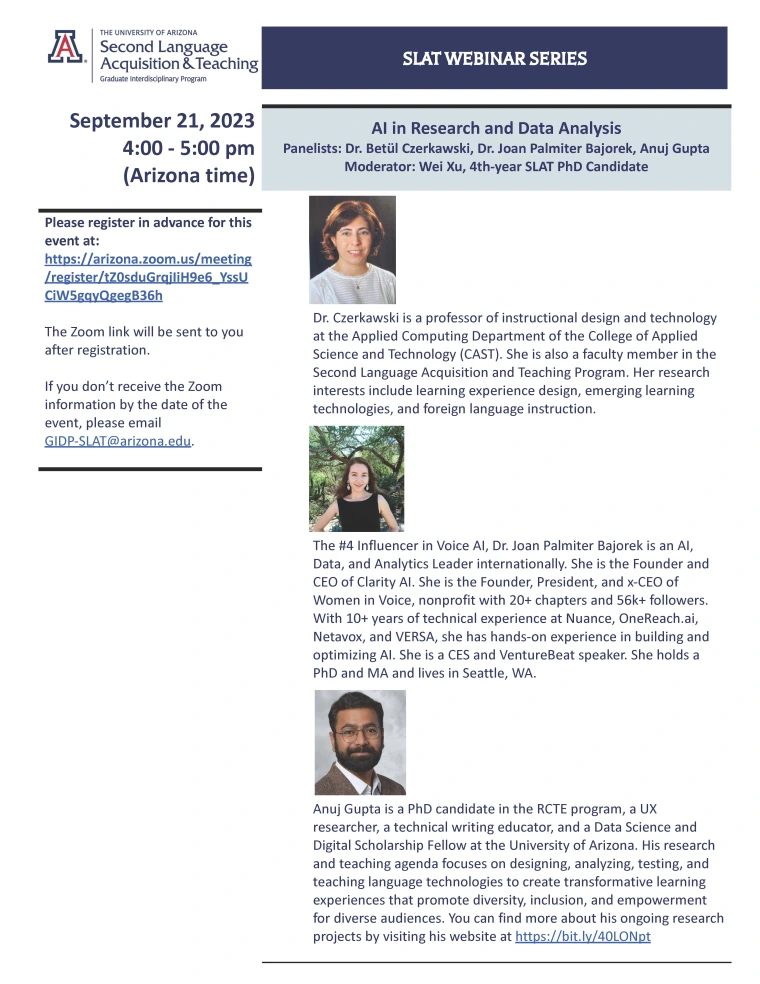
Dr. Betul Czerkawski, Dr. Joan Palmiter Bajorek, Anuj Gupta
Panelists: Dr. Betul Czerkawski, Dr. Joan Palmiter Bajorek, Anuj Gupta
Moderator: Wei Xu, 4th-year SLAT PhD Candidate
Panelist Bios:
Dr. Betül Czerkawski is a professor of instructional design and technology at the Applied Computing Department of the College of Applied Science and Technology (CAST). She is also a faculty member in the Second Language Acquisition and Teaching Program. Her research interests include learning experience design, emerging learning technologies, and foreign language instruction.
The #4 Influencer in Voice AI, Dr. Joan Palmiter Bajorek is an AI, Data, and Analytics Leader internationally. She is the Founder and CEO of Clarity AI. She is the Founder, President, and x-CEO of Women in Voice, nonprofit with 20+ chapters and 56k+ followers. With 10+ years of technical experience at Nuance, OneReach.ai, Netavox, and VERSA, she has hands-on experience in building and optimizing AI. She is a CES and VentureBeat speaker. She holds a PhD and MA and lives in Seattle, WA.
Anuj Gupta is a PhD candidate in the RCTE program, a UX researcher, a technical writing educator, and a Data Science and Digital Scholarship Fellow at the University of Arizona. His research and teaching agenda focuses on designing, analyzing, testing, and teaching language technologies to create transformative learning experiences that promote diversity, inclusion, and empowerment for diverse audiences. You can find out more about his ongoing research projects by visiting his website at https://bit.ly/40LONpt
Please register in advance of the webinar by filling out this form: https://arizona.zoom.us/meeting/register/tZ0sduGrqjIiH9e6_YssUCiW5gqyQg…;After registering, you’ll receive a confirmation email with the Zoom link for the webinar. You’ll also be able to submit advance questions for the panelists within the registration form.
We look forward to seeing you on September 21st at 4:00 pm (Arizona time)!
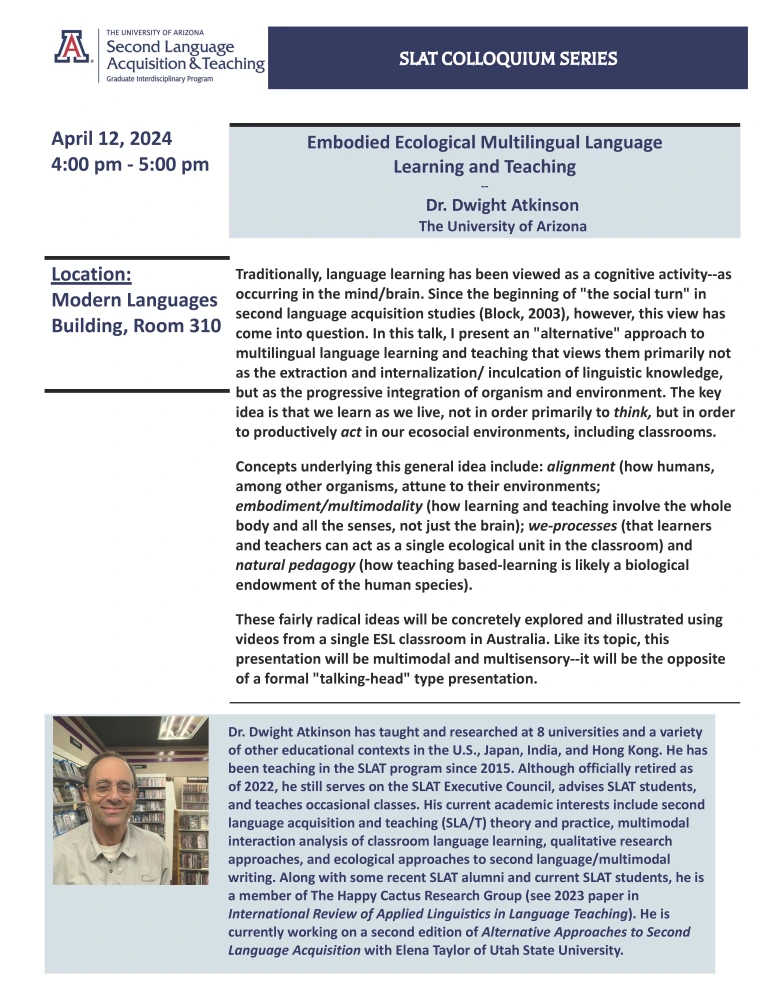
Embodied Ecological Multilingual Language Learning and Teaching
Colloquium Title: Embodied Ecological Multilingual Language Learning and Teaching
Abstract: Traditionally, language learning has been viewed as a cognitive activity--as occurring in the mind/brain. Since the beginning of "the social turn" in second language acquisition studies (Block, 2003), however, this view has come into question. In this talk, I present an "alternative" approach to multilingual language learning and teaching that views them primarily not as the extraction and internalization/inculcation of linguistic knowledge, but as the progressive integration of organism and environment. The key idea is that we learn as we live, not in order primarily to think, but in order to productively act in our ecosocial environments, including classrooms.
Concepts underlying this general idea include: alignment (how humans, among other organisms, attune to their environments; embodiment/multimodality (how learning and teaching involve the whole body and all the senses, not just the brain); we-processes (that learners and teachers can act as a single ecological unit in the classroom) and natural pedagogy (how teaching based-learning is likely a biological endowment of the human species).
These fairly radical ideas will be concretely explored and illustrated using videos from a single ESL classroom in Australia. Like its topic, this presentation will be multimodal and multisensory--it will be the opposite of a formal "talking-head" type presentation.
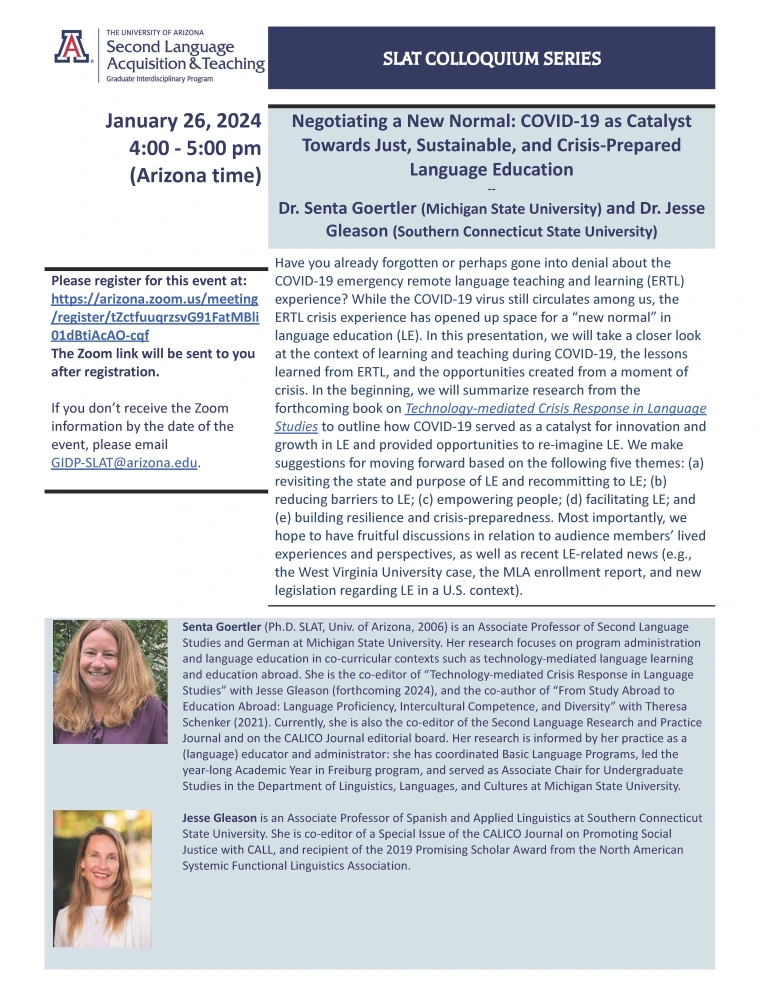
Negotiating a New Normal: COVID-19 as Catalyst Towards Just, Sustainable, and Crisis-Prepared Language Education
Colloquium Title: Negotiating a New Normal: COVID-19 as Catalyst Towards Just, Sustainable, and Crisis-Prepared Language Education
Abstract: Have you already forgotten or perhaps gone into denial about the COVID-19 emergency remote language teaching and learning (ERTL) experience? While the COVID-19 virus still circulates among us, the ERTL crisis experience has opened up space for a "new normal" in language education (LE). In this presentation, we will take a closer look at the context of learning and teaching during COVID-19, the lessons learned from ERTL, and the opportunities created from a moment of crisis. In the beginning, we will summarize research from the forthcoming book on Technology-mediated Crisis Response in Language Studies to outline how COVID-19 served as a catalyst for innovation and growth in LE and provided opportunities to re-imagine LE. We make suggestions for moving forward based on the following five themes: (a) revisiting the state and purpose of LE and recommitting to LE; (b) reducing barriers to LE; (c) empowering people; (d) facilitating LE; and (e) building resilience and crisis-preparedness. More importantly, we hope to have fruitful discussions in relation to audience members' lived experiences and perspectives, as well as recent LE-related news (e.g., the West Virginia University case, the MLA enrollment report, and new legislation regarding LE in a U.S. context).
Please register for this event at: https://arizona.zoom.us/meeting/register/tZctfuuqrzsvG91FatMBli01dBtiAcAO-cqf The Zoom link will be sent to you after registration.
Dr. Senta Goertler (Ph.D. SLAT, University of Arizona, 2006) is an Associate Professor of Second Language Studies and German at Michigan State University. Her research focuses on program administration and language education in co-curricular contexts such as technology-mediated language learning and education abroad. She is the co-editor of “Technology-mediated Crisis Response in Language Studies” with Jesse Gleason (forthcoming 2024), in which they present lessons from the COVID-19 pandemic; and the co-author of “From Study Abroad to Education Abroad: Language Proficiency, Intercultural Competence, and Diversity” with Theresa Schenker (2021), where they argue for the revitalizing the Junior Year Abroad and diversification of education abroad. Currently, she is also the co-editor of the Second Language Research and Practice Journal and on the CALICO Journal editorial board. Her research is informed by her practice as a (language) educator and administrator: she has coordinated Basic Language Programs, led the year-long Academic Year in Freiburg program, and served as Associate Chair for Undergraduate Studies in the Department of Linguistics, Languages, and Cultures at Michigan State University.
Dr. Jesse Gleason is an Associate Professor of Spanish and Applied Linguistics at Southern Connecticut State University. She is co-editor of a Special Issue of the CALICO Journal on Promoting Social Justice with CALL, and recipient of the 2019 Promising Scholar Award from the North American Systemic Functional Linguistics Association.
Toward More Effective Technology Integration: The PICRAT Model
Colloquium Title: Toward More Effective Technology Integration: The PICRAT Model
Abstract: Technology has a complicated history with education. At times, tech has shaped learning in positive and unexpected ways, and at other times, it has had serious negative impacts. Generally, though, most of the promises made by tech throughout history have had no effect on learning. As new technologies emerge, how should educators navigate them, determine what is worth their time, and discern what is beneficial for learners? This talk introduces the PICRAT model of technology integration, which can serve as a simple heuristic to help teachers, developers, and designers understand the actual benefits of technology for learning and how to improve teaching practices to practically leverage technologies to have a transformative effect on their students, schools, and communities.
Speaker Bio: Dr. Royce Kimmons is an Associate Professor of Instructional Psychology and Technology at Brigham Young University. His scholarly work focuses on open education, social media in education and society, and classroom technology use (e.g., PICRAT). He is also the founder of EdTechBooks.org, a widely-used open publishing platform that removes access barriers for learners across the world. More about his work may be found on his website at http://roycekimmons.com/.
Please register for this colloquium at: https://arizona.zoom.us/meeting/register/tZMsfuutrDsiGNEZE084L-9fr9RUT-qGxMya The Zoom link will be sent to you after registration. If you don’t receive the Zoom information by the date of the event, please email GIDP-SLAT@arizona.edu.
Intersectionality in Critical Applied Linguistics
Colloquium Title: Intersectionality in Critical Applied Linguistics
Abstract: Intersectionality draws upon the multiplicity, relationality, and complexity of identities in explaining how (in)equality, power, and (in)justice are formed in a particular context that faces the challenges and crisis of its time. In critical applied linguistics, intersectionality (e.g., Crenshaw, 1989, 1991) can be used as an analytic framework to understand intersecting forms of power in multicultural and multilingual contexts, as a reflexive approach for analyzing the complexity of an individual's experience, and "as a guiding structure for promoting new identities and new forms of democratic activities" among marginalized communities (Collins & Bilge, 2016, p. 43). One challenge of our time is increased global migration and displacements. Global migration and displacements not only change demographics but also significantly shape language access and use. This talk thus begins with an overview of 'intersectionality' and a discussion of global migration through an intersectionality lens. It then moves on to understanding intersectional identities in the context of global migration. The talk concludes with a critical intersectional agenda for applied linguists, as they continue to build a much-needed, critical, and vibrant scholarship through an intersectionality lens for a socially-just world.
References:
Dr. Hayriye Kayi-Aydar is an Associate Professor of English Applied Linguistics/TESOL and SLAT at the University of Arizona. Often using narrative inquiry and discourse analysis approaches, her qualitative research focuses on the professional/intersectional identities and agency of teachers in multilingual contexts. Her publications, in most of which she documents marginalized or minoritized identities, have appeared in various peer-reviewed journals, such as TESOL Quarterly, Teaching and Teacher Education, System, TESOL Journal, and Language Teaching. She is the author of the monograph Positioning theory in applied linguistics: Research design and applications (Palgrave MacMillan, 2019) and co-editor of three books.
To help us get an idea of how many people will be attending, please RSVP through this linked form. Please email GIDP-SLAT@arizona.edu with any questions.
Teacher Digital Competence in Pre-service and In-service English Language Teachers: Reflections from a Doctoral Study guided by DigCompEdu Framework
Colloquium Title: Teacher Digital Competence in Pre-service and In-service English Language Teachers: Reflections from a Doctoral Study guided by DigCompEdu Framework
Abstract: This colloquium presents reflections from a mixed-method PhD dissertation that examines the impact of teacher digital competence development programs tailored specifically for pre-service and in-service English language teachers. The study engaged two distinct groups: one comprised of pre-service English teachers at a university, and the other involving in-service English teachers participating in an online professional development series. The study found statistically significant improvements in the digital competencies of both sets of teachers over time. This colloquium will unpack these findings to provide a nuanced understanding of frameworks on teacher digital competence and how teacher digital competence evolves in teaching professionals. It will also offer valuable insights into the observed benefits, challenges, and opportunities for further research and program development.
Please register for this event at: https://arizona.zoom.us/meeting/register/tZMvc-2srTgiGNI3AxJpVb3_8vOyRSAIB8uf The Zoom link will be sent to you after registration.
Dr. Cemil Gokhan Karacan works as an Assistant Professor in the Department of English Language Teaching at Istanbul Medipol University in Turkey. A graduate of Istanbul University's Engish Language Teaching Department, he earned his MA and PhD in ELT from Bahcesehir University. His professional experience spans teaching English at various private and foundation institutions, and interpreting. His research interests include pre-service English language teacher education, pre-service and in-service teacher digital competence and emerging educational technologies, particularly educational augmented reality. He has published a number of research articles, book chapters and magazine pieces in international academic outlets.
Adapting Language Education to the AI Landscape: Insights from the Center for English as a Second Language
Title of Colloquium: Adapting Language Education to the AI Landscape: Insights from the Center for English as a Second Language
Co-Presenters: Dr. Sumayya Granger (University of Arizona - CESL), Julianne Hammink (University of Arizona - CESL), Aziz Yuldashev (University of Arizona - CESL)
Abstract: In this panel, we will explore questions around the use of AI in teaching, learning, and assessment, specifically in the context of language programs. We will share our experiences with AI at the Center for English as a Second Language, including preparing students to be responsible and effective users of generative AI, the impact of AI on assessment practices, and overall questions of the role of language learning in higher education.
Please see the attached flyer for speaker bios and more information about the colloquium.
To attend this colloquium, please email GIDP-SLAT@arizona.edu.
The 9th International Conference on the Development and Assessment of Intercultural Competence
The 2024 ICC Conference will be on the topics of Intercultural Learning, Global Citizenship, and Peacebuilding. The conference will be organized by CERCLL, and more information can be found at the ICC website: https://icc.arizona.edu/.
For questions about submitting a proposal or about the ICC Conference, email cercll@arizona.edu.
The details about the SLAT comprehensive exam process
This workshop will cover what to expect from the comprehensive exam process, when to start putting committees together, how to put together reading lists, how to tie in your dissertation proposal topic, and much more. All SLAT students in their 2nd and 3rd years (especially those who are taking comps during 2023-2024) are required to attend, but all SLAT students from any cohort are welcome.
Presenter: Dr. Suzanne Panferov Reese